Skip to content
Agents at Work

How AI Agents Work With Existing Business Systems 

We spent years teaching computers how to follow instructions. The interesting part begins when they start understanding what needs to be done next.

AI does not become useful at work when you give it a bigger vocabulary. It becomes useful when you give it somewhere to work. 

That means connecting it to the systems where the actual work already happens. 

For years, businesses have accumulated software for everything. Payroll has its own system. HR has another. Finance has another. Sales, customer support, attendance, project management, and operations all have their own tools. 

The problem was never a lack of software. 

It was getting all of it to work together. 

AI agents are changing that conversation. Instead of creating another tool that employees must open, learn and maintain, an AI agent can work with the systems a business already uses, helping move information and tasks between them. 

That sounds easy. In practice, there is quite a bit going on underneath it. 

An AI agent needs more than intelligence

An AI agent can be exceptionally good at understanding language, recognising patterns or deciding what needs to happen next. But none of that is particularly useful if it has no access to the information needed to act. 

While we talk about a simple HR process. 

An employee applies for leave. The relevant information may need to be checked against their leave balance, attendance records and other HR information before the request is approved or passed on. 

An AI agent sitting completely outside those systems can tell someone what a leave policy says. 

An agent connected to the right business systems can work with the information that matters to the request. 

That is the important distinction. 

AI provides the reasoning. Business systems provide the context. 

When the two work together, AI starts becoming part of the workflow rather than another place to ask questions.

Existing systems do not suddenly become obsolete

There is often an assumption that adopting AI means replacing older software with something new. 

That is not necessarily how it works. 

Most businesses have already invested considerable time, money, and effort into the systems they rely on. Those systems hold years of information and are built around processes employees already understand. 

Replacing everything just to introduce AI would be a strange way to make technology simpler. 

A more practical approach is to let AI work with what is already there. 

An AI agent can sit between people and existing systems, depending on how it is designed and what access it has. It can interpret a request, find the relevant information, perform an authorised action, or hand the task back to a person when a decision is needed. 

The existing system stays the source of the underlying business information. 

AI simply gives people another, more intelligent way to interact with it. 

The real work happens behind the scenes

Imagine someone in HR needs to understand why a payroll figure has changed. 

Normally, that might involve opening one system, checking employee information, looking at attendance, reviewing leave or timesheets, and then comparing the relevant records. 

None of those steps is particularly difficult. 

The frustration comes from having to repeat them across different systems, screens, and processes. 

An AI agent connected to the relevant business applications can potentially bring those pieces together. It can understand what the person is trying to investigate, retrieve the information it has permission to access and help surface what matters. 

The person does not necessarily need to know which screen has which piece of information. 

That is one of the more interesting changes AI can bring to business software: the user can focus more on the task and less on navigating the software required to complete it.

But connection does not mean giving AI unlimited access

This is where the conversation needs a little realism. 

Connecting an AI agent to a business system is not simply a matter of giving it a username and letting it loose. 

Business systems have sensitive information. Payroll has financial data. HR systems have employee information. Finance systems have information that should not be casually accessed or changed. 

An AI agent therefore needs boundaries. 

It needs to know what information it can access, which actions it is allowed to take and when it should stop and ask a human to step in. 

That human oversight is not a weakness in the system. In many business processes, it is part of what makes the system trustworthy. 

The aim is not to create an AI that can do everything. 

It is to create one that knows what it can do, what it should do and when it should leave the decision to a person. 

From integrations to actual workflows

There is another important distinction here. 

Businesses have had integrations for years. One system sends information to another, a report pulls data from somewhere else, and different applications communicate in the background. 

AI agents add another layer to that relationship. 

Instead of simply moving data from A to B, an agent can potentially understand what the information means in the context of a task and find what needs to happen next. 

That makes the conversation less about connecting software and more about connecting work. 

For example, an HR process may involve employee information, attendance, leave, and payroll. These systems do not become useful merely because they can exchange data. The real value comes when that connection helps a person complete an actual piece of work with less unnecessary effort. 

This is where an HR ecosystem starts to matter

For Whatnxt, this is particularly relevant because the idea is not to force every business into one fixed setup. 

A business may begin with one HR application and later add modules such as Payroll, Leave Management, Attendance or Timesheets as its requirements grow. 

As those systems become more connected, there is more context for AI to work with. 

An AI agent can become another layer across that ecosystem, helping people interact with information and processes without turning every task into a hunt through different applications. 

The important part is that the underlying systems still have a job to do. AI does not replace the business logic, records, or processes that organisations depend on. 

It works with them.

The future may be less about adding software

We have spent years solving workplace problems by adding another application. 

Need better attendance tracking? Add a system. 

Need better reporting? Add another one. 

Need automation? Find another tool. 

AI agents offer a different possibility. 

Instead of asking, what new software do we need? businesses can start asking, how can the software we already have work harder for the people using it? 

That is a more interesting question. 

Because the future of AI at work may not be about replacing everything that came before it. It may be about making the systems businesses already depend on easier to use, more connected and more capable of taking part in the work itself. 

And when AI can understand the systems, the information, and the task in front of it, the technology finally starts working where the work happens. 

  • When AI Stops Answering and Starts Doing: The Rise of AI Agents at Work 
    Agents at Work 6 min

    When AI Stops Answering and Starts Doing: The Rise of AI Agents at Work 

    You could ask it to summarise a document, explain a problem, draft an email, or help you find information, and within seconds you had something to work with. That alone changed the way many people approached everyday tasks.

    6 min
  • Your Salesforce Has Data. But Can You Actually Trust It? 
    Agents at Work 6 min

    Your Salesforce Has Data. But Can You Actually Trust It? 

    Most businesses have no shortage of data sitting inside Salesforce. There are customer records, leads, opportunities, contact details, sales activities and years of information gathered by different teams at different points in the customer journey. From the outside, it can look like a complete picture of the business.

    6 min
  • Inside Whatnxt: Building an Ecosystem of AI Solutions 
    Agents at Work 6 min

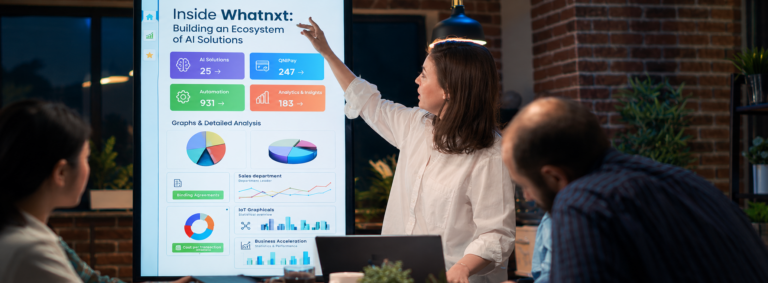
    Inside Whatnxt: Building an Ecosystem of AI Solutions 

    Most businesses have no shortage of data sitting inside Salesforce. There are customer records, leads, opportunities, contact details, sales activities and years of information gathered by different teams at different points in the customer journey. From the outside, it can look like a complete picture of the business.

    6 min