Skip to content
AI in the Workplace

From AI Assistant to AI Coworker: How Work Is Changing

We spent years teaching computers how to follow instructions. The interesting part begins when they start understanding what needs to be done next.

We spent years teaching computers how to follow instructions. The interesting part begins when they start understanding what needs to be done next. 

For a while, AI had a manageable role at work. You opened a tool, gave it a prompt, and waited for an answer. It could draft an email, summarise a document or analyse information, but there was still a clear line between you doing the work and AI helping you do it. 

That line is beginning to blur. 

The next generation of workplace AI is moving beyond answering prompts and towards taking part in the work itself. Instead of simply helping someone complete a task, AI can become part of the workflow, working with context, handling defined parts of a process, and bringing something back to a person when human judgement is needed. 

That is the move from an AI assistant to an AI coworker. 

An assistant waits. A coworker understands the work. 

The difference becomes clearer when you look at what each one does. 

An AI assistant can help an HR team write an onboarding email or create a checklist. An AI coworker sits closer to the process. It can understand the information relevant to a task, work through the steps it has been given and help move the process forward. 

The difference is not simply about intelligence. It is about the role AI plays. 

For years, software has been designed around people using systems, finding information, completing actions, and moving on. When two systems do not communicate, a person becomes the bridge. When information must be collected from several places, someone gathers it. When a process requires repeated checks, someone performs them. 

AI creates an opportunity to change some of that arrangement. 
Context is what makes AI useful

The most useful AI at work will not work in isolation. 

Consider an HR environment. Employee information may sit alongside attendance, leave, timesheets, payroll and other processes. Each serves a purpose, but the real value often comes from understanding how those pieces relate. 

Give AI a blank screen and it can give you a generic answer. 

Give it relevant business context and it can move from generating something that sounds right to helping with something that is relevant to the organisation. 

That difference becomes increasingly important when AI is being used inside business processes rather than simply for content generation. 

The real shift is from answers to action

The first generation of AI made it easier to get information. The next generation is increasingly about what happens after you get it. 

Instead of asking AI to summarise a report and then figuring out what to do with it yourself, AI can become part of the process that follows. It can potentially handle more of the steps between information and action. 

The human does not disappear from the process. In many cases, the human becomes more important at the points where judgement, context, or accountability matter. 

The technology takes care of more of the groundwork. 

Not everything needs to be automated

There is a temptation to think that AI coworkers mean handing entire jobs over to machines. Real work is rarely that simple. 

Most roles have repetitive tasks, decisions, conversations, exceptions, and situations that require experience. Some parts can be automated comfortably. Others should remain firmly in human hands. 

The opportunity lies in separating the two. 

An HR professional should not have to spend valuable time repeatedly collecting the same information or checking routine details simply because systems cannot connect the dots. At the same time, a sensitive employee conversation cannot be reduced to a workflow simply because technology can process the underlying data. 

AI can handle more of the repetitive ground between those moments, allowing people to spend more time where their judgement matters. 

The goal is not to make people unnecessary. It is to stop making people the glue that holds every process together.

Whatnxt and the AI-powered HR ecosystem

This is where the broader idea behind Whatnxt becomes relevant. 

Whatnxt is designed as an HR ecosystem where businesses can start with the applications they need and build towards a more connected setup as their requirements evolve. AI becomes more useful when it can work with the systems and information already forming part of the organisation. 

The future is unlikely to be one giant AI tool replacing every piece of business software. It is more likely to be an ecosystem where applications, information, and AI work together, helping people navigate processes and act without constantly moving between disconnected tools. 

That is a much more practical vision of AI at work. 

The coworker is changing what we expect from software

The coworker is changing what we expect from software 

The most interesting thing about AI coworkers is not simply that they can write faster or answer questions more quickly. 

They change what we expect software to do. 

We have become accustomed to software waiting for us. We click, search, enter, approve, and repeat. AI introduces the possibility of software that can understand the context around a task, handle defined pieces of it and know when to bring a person back into the loop. 

AI is moving from something we use to something we work with. 

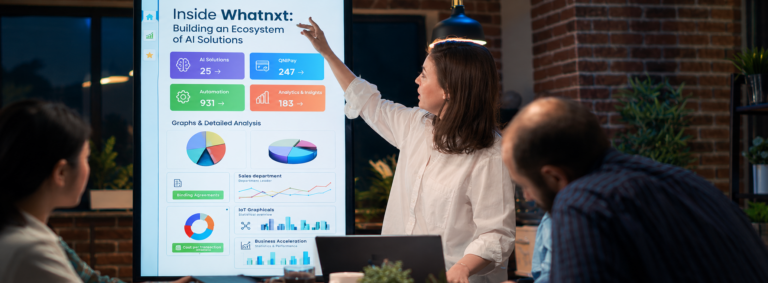
  • Inside Whatnxt: Building an Ecosystem of AI Solutions 
    Agents at Work 6 min

    Inside Whatnxt: Building an Ecosystem of AI Solutions 

    Most businesses have no shortage of data sitting inside Salesforce. There are customer records, leads, opportunities, contact details, sales activities and years of information gathered by different teams at different points in the customer journey. From the outside, it can look like a complete picture of the business.

    6 min
  • The New Skill: Knowing What to Delegate to AI 
    AI in the Workplace 6 min

    The New Skill: Knowing What to Delegate to AI 

    The hardest part of using AI at work may not be figuring out what it can do. It may be deciding what you are comfortable letting it do. Let us think about how delegation normally works. A manager might ask someone to prepare a report but still want to look at it before it goes out.

    6 min
  • When AI Stops Answering and Starts Doing: The Rise of AI Agents at Work 
    Agents at Work 6 min

    When AI Stops Answering and Starts Doing: The Rise of AI Agents at Work 

    You could ask it to summarise a document, explain a problem, draft an email, or help you find information, and within seconds you had something to work with. That alone changed the way many people approached everyday tasks.

    6 min